- hope@aswinonco.in
- Chennai, Tamil Nadu (Online consults for NRI / pan-India)
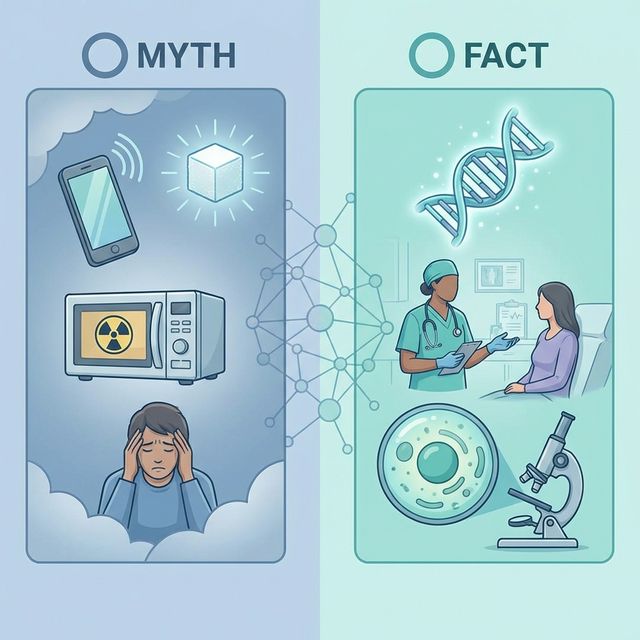
In the age of WhatsApp forwards and social media, misinformation travels faster than facts. When you or a loved one is diagnosed with cancer, this misinformation can be dangerous. It can lead to fear, delayed treatment, or harmful lifestyle choices.
Let’s bust the top 7 myths we encounter daily in our clinic.
"Fear spreads faster than cancer. Knowledge is the only vaccine against fear."
The Fact: All cells, including cancer cells, use glucose (sugar) for energy. But cutting out sugar completely does not stop cancer. However, a high-sugar diet leads to obesity, and obesity IS a major risk factor for 13 types of cancer (including breast and colon). So, limit sugar to stay lean, not to starve the tumor directly.
The Fact: You cannot catch cancer like the flu. You can hug, kiss, and share meals with a cancer patient safely. The only exception is certain viruses that cause cancer (like HPV or Hepatitis B) which are contagious, but the cancer itself is not.
The Fact: This is an old fear. Modern needle biopsies are extremely safe. The risk of seeding (spreading cells along the needle track) is infinitesimally small compared to the risk of not knowing what the tumor is. A biopsy is essential for the correct diagnosis.
The Fact: No single food (be it blueberries, turmeric, or green tea) can cure cancer. They are healthy and support the body during treatment, but they cannot replace chemotherapy or surgery. Used alone, they allow the cancer to grow unchecked.
The Fact: Arsenic is natural. Snake venom is natural. "Natural" does not mean safe. Some herbal supplements interfere with chemotherapy, making it toxic or ineffective. Always tell your oncologist about everything you are taking.
The Fact: These devices emit non-ionizing radiation (low energy). They do not have enough energy to damage DNA. Decades of research have found no conclusive link between cell phone use and brain tumors.
The Fact: Only 5-10% of cancers are hereditary. The vast majority (90-95%) are "sporadic," caused by aging, lifestyle (smoking, diet), and environmental factors. Everyone needs to follow screening guidelines, regardless of family history.
The Fact: This is a common fear based on older movies or stories from decades ago. Modern cancer treatment has evolved significantly. We now have:
While treatment affects the body, untreated cancer is almost always fatal and causes severe suffering. Treatment offers the hope of cure and life.
The Fact: This myth was popularized to sell shark cartilage supplements. The truth is, sharks do get cancer. Scientists have found tumors in sharks. More importantly, clinical trials have shown that shark cartilage supplements do not fight cancer in humans.
The Fact: While a positive attitude helps you cope better and adhere to treatment, there is no evidence that it cures cancer by itself. Patients shouldn't feel guilty or responsible if their cancer progresses despite being "positive." Cancer is a biological process, not a result of negative thinking.
Myths survive because they offer simple answers to a complex and frightening problem. It feels easier to believe "sugar causes cancer" (something you can control) than "genetic mutations cause cancer" (something you can't always control). However, trusting science gives you the best chance of survival.
Before you believe a "miracle cure" you see online, run it through this checklist:
To truly understand why these myths are wrong, it helps to know how cancer works:
Because cancer is complex and biological, simple "cures" like cutting sugar or taking herbs cannot fix the underlying genetic mutations.
There is no scientific evidence that stress directly causes cancer. However, chronic stress can lead to unhealthy behaviors like smoking, overeating, or drinking alcohol, which ARE risk factors.
No. The National Cancer Institute has found no evidence linking underarm hygiene products to breast cancer. This is a common internet rumor that has been debunked.
No. The body tightly regulates its pH balance. What you eat cannot significantly change the pH of your blood. While eating more vegetables (alkaline) is healthy, it's because of the nutrients, not the pH.