- hope@aswinonco.in
- Chennai, Tamil Nadu (Online consults for NRI / pan-India)
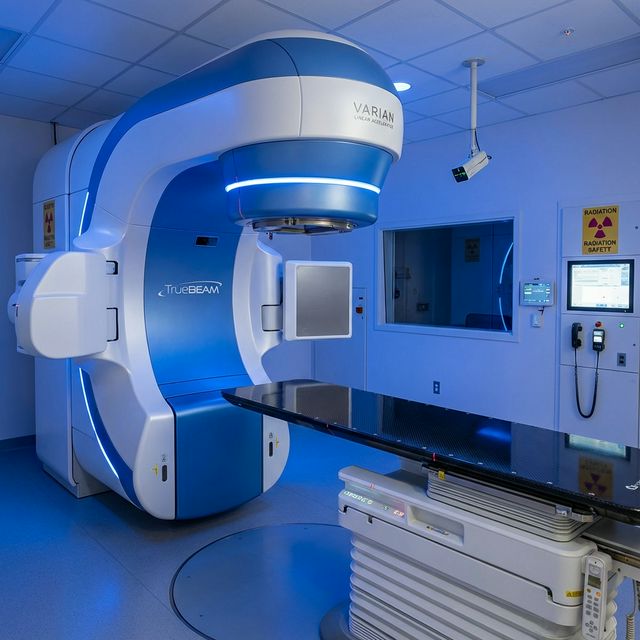
When patients hear "radiation," they often think of burns or nuclear disasters. In reality, modern radiation therapy is one of the most precise and safe tools we have against cancer. It uses high-energy particles (x-rays, gamma rays, protons) to destroy or damage cancer cells.
Radiation works by making small breaks in the DNA inside cells. These breaks keep cancer cells from growing and dividing and cause them to die. Nearby normal cells can also be affected, but they can repair themselves in a way that cancer cells cannot.
This is the most common type. A machine basically "photocopies" high-energy beams into your tumor from outside the body. You lie entirely still, usually with a custom mold to keep you in place. It is painless and feels just like getting an X-ray.
A radioactive source is placed inside your body, into or near the tumor. This allows a very high dose to the tumor with very little dose to surrounding organs. It is commonly used for cervical, prostate, and breast cancers.
With external radiation (EBRT), NO. You do not become radioactive. It is safe to be around pregnant women and children immediately after your session. For internal radiation (implants), you may have temporary restrictions.
You may get a skin reaction that looks like a sunburn (redness, dryness) in the treatment area only. It usually heals within a few weeks of finishing treatment. We prescribe specific lotions to manage this.
Treatment usually happens 5 days a week (Monday-Friday) for several weeks. Each session takes only about 15-30 minutes.
Radiation side effects don't start immediately. They build up over time (cumulative effect).
| Week | Possible Side Effects |
|---|---|
| Week 1-2 | Usually no side effects. You will feel normal. |
| Week 3-4 | Mild fatigue sets in. Skin may start turning pink/red (like a mild sunburn). |
| Week 5-6 | Fatigue increases (need afternoon naps). Skin may peel or darken. Sore throat (if treating head/neck). |
| Post-Treatment | Side effects peak 1-2 weeks after radiation ends, then gradually fade. Most are gone by 4-6 weeks post-treatment. |
Think of your treated skin as "sun-sensitive."
Radiation burns calories as your body repairs itself.
A common worry is, "Can I hug my children after treatment?"
Radiation effects can linger. Years later, you might notice changes in the treated area:
Only in the area being treated. If you are getting radiation to your hip, you will not lose hair on your head. If treating the brain, you will lose scalp hair.
Yes, most patients drive themselves during the early weeks. Towards the end, fatigue might make driving unsafe, so having a backup driver is a good plan.
No. This is a movie myth. You leave the treatment room completely radiation-free.